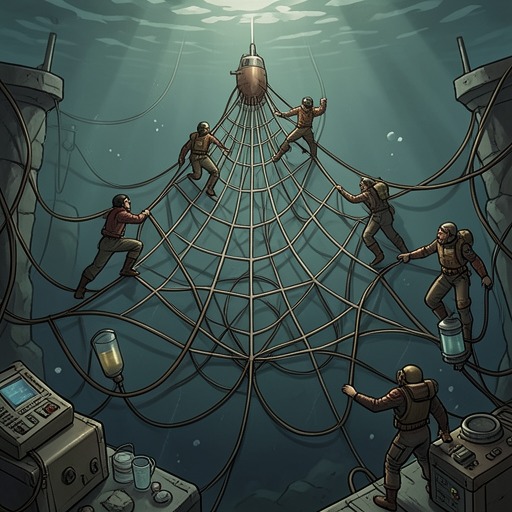
The spider-and-fly metaphor
The TrenchThe spider-and-fly metaphor is Benedict’s account of how he gains and maintains power: he casts himself as the provider of purpose and safety, but the image also exposes the trap concealed in that offer. In his exchange with Terry aboard the Prometheus, the web is at once a theory about his crew, a justification for his authority, and an implied description of the danger facing her.
The Web as a System of Authority
Benedict describes his crew as men he selected and trained because their lives had lost direction. In his account, money alone cannot explain why they risk their lives: he claims to have supplied the purpose they lacked and to have made an honorable death seem preferable to a life without dignity. He presents his influence as both feared and valued, casting himself as the power that fills an emptiness in the men’s lives. The spider’s web therefore stands for more than command over a workforce. It represents a relationship in which belonging and obedience are offered as remedies for despair.
That account contains its own explanation of the trap. Benedict says the men could leave, but argues that those who have done so returned to destructive personal problems, including substance use. He describes them as having surrendered their free will to a higher authority: himself. His version of their dependence makes his control appear necessary, because the alternative is portrayed as a return to the conditions from which he claims to have rescued them. The structure is circular: Benedict offers purpose, treats that purpose as a reason to obey, and invokes the men’s possible collapse outside his command as evidence that they cannot safely leave.
Salvation and Predation
Terry tests Benedict’s account by asking whether the crew’s risk is simply an exchange for high pay. Benedict rejects money as a sufficient motive and emphasizes a shared belief in the mission, while distinguishing his crew from those who, like Terry and himself, supposedly act from conviction. His explanation shifts between rescue and domination. He claims to have given the men a reason to live, yet also says that fear of his anger drives them into extreme danger. The web holds these two claims together: the crew is invited to see its dependence as salvation, while obedience is secured through fear.
Terry makes that contradiction explicit. She compares Benedict’s organization to a cult and describes him as a leader who exploits fear. Benedict does not simply deny the charge. He considers whether he preys on fear, then generalizes the issue into an argument about human nature, asserting that fear has repeatedly enabled people to dominate others. By treating intimidation as a universal feature of leadership, he makes his own conduct seem less like a choice than an unavoidable expression of power. The spider image gives that reasoning a concrete shape: the predator can call the web a refuge, but the fly remains caught within it.
Terry as the Fly
The metaphor becomes more pointed when Benedict turns from describing his crew to Terry’s presence aboard the Prometheus. He says he has mastered fear, though he does not claim to be without it, and explains that the crew follows him into danger because it fears his wrath. Terry responds nervously by asking permission to spend her last day in the abyss aboard the vessel, saying that she expects to return to the surface the next day. Her request makes the conversation’s abstract argument immediate: she is seeking access to a place and an experience controlled by Benedict.
Benedict interprets her choice as evidence that she wants to remain despite the possibility of death. Terry denies being afraid, but the narration identifies this denial as a lie. Her stated wish to explore the Trench and his insistence that fear can make people act against their own wishes leave the question of freedom unsettled. She may describe her presence as voluntary, but the exchange places that claim inside a relationship structured by his authority and her awareness of danger. The metaphor does not establish that Terry has already been trapped; it makes her position resemble the fly’s before the web closes.
Repetition and Significance
The image develops through repetition rather than remaining a passing comparison. Terry first uses it to name the structure she sees beneath Benedict’s offer of salvation. Later, as he leans over the light table, the narration briefly likens his expression to a snake poised to strike; Benedict then addresses Terry through the spider-and-fly image again, welcoming her into his web. The renewed figure changes the metaphor’s force. What had served as Terry’s criticism becomes Benedict’s own language for the encounter, as if he accepts the description while claiming the power to define its terms.
Its central tension is between the promise of rescue and the reality of dependence. Benedict’s story of the crew may describe why they follow him, but it is also the justification by which he makes their obedience seem deserved and necessary. With Terry, the web is less a settled fact than a warning: his control of the vessel and his account of fear press against her stated freedom to choose. The metaphor distills that conflict without resolving it, leaving the apparent offer of welcome shadowed by the possibility of entrapment.